Dystopia, IRL

Parable of the Sower (1993). The Wilderness (2025). Assata (1987).

One, a dystopia set in what is now present day. The second, a searing  contemporary reflection of how we somehow manage to balance light heartedness and impending doom. And third, a stark reminder that the doom is not impending, nor has it already befallen us, rather, it is our very foundation.

The doom is what forced Assata to exile, it’s what colored Octavia’s imagination of a world in which the doom would no longer be deniable, and it’s also what impelled a reality in which revolution sometimes looks like joy and sometimes looks like just getting by and sometimes looks like the wilderness that Angela so beautifully and accurately conjured.

The Wilderness explores adulting through its many phases: life and love, birth and death, friendship and romance. All of these against the backdrop of a burning world and a crumbling empire, our very own IRL dystopia.

In our world, the language of dystopia flows through our daily conversations. Talk of wildfires at dinner with friends and kettling during coffee break in the office kitchen, or more likely when you linger on the zoom with your work bestie.

This is the world we know. Assata and Parable of the Sower remind us that this is the world we’ve always known. Despite the growing discomforts, nothing feels quite like home more than the status quo.

This doom has been looming overhead for generations. Dark, imposing storm clouds, mollifying our outrage by occasionally shapeshifting into a light fog, easing our fears of a flood while never quite clearing our vision. But little did we know, it’s actually us who control the weather. Our compassion the sun, our empathy the blue skies, our love the key to a beautiful day.

Parable of the Sower (1993). The Wilderness (2025). Assata (1987). I wasn’t sure what led me to read these three books one after the other. But, whatever or whoever, I’m grateful for the reminder that while death is certain, it doesn’t have to be imminent. We decide if the sun will shine on only a select few or if it will warm all of humanity.

Signed,

N.A.

destiny, my old friend

I remember my future clearly
nestled in the coziest recesses of my mind
vivid in my heart’s eye

have you ever been so sure of your destiny
it’s as if it already happened

I have. I am.
my future is had,
is

Ekeọma
good destiny
o kere m ya k’ọma

Ekee
cut, divide, set apart
removed and saved specially
for me
made and given
to me

Ọma
good as the purest soul
good as an eyes closed, chin titled, mmmm
good as of God, divine

My destiny summons me
trusts that I know her voice
undeniably familiar
she’s been calling
and I’ve been answering
since my beginning

nke o kere m
I know you
I remember you
until we meet again.

Ekeoma Sunday Ezeh

Aunty grew up with my dad, she was like a sister to him. When Aunty told me she would like to keep in touch, she input my name in her phone, then offered it to me to input my number. I was pleasantly surprised by what I saw: first name – Ekeoma, last name – Sunday Ezeh (my father’s full name). Today marks 20 years since my father’s death. As someone whose dad has been gone for that long, the vast majority of people in my life never knew my dad. Which means, I usually have to rely on myself for a reminder that I am my father’s daughter, Sunday Ezeh’s daughter.

In Igbo culture, it is common to be known by many names. Of course you have the names your parents give you, which usually end up on your official documents. However, it is also common for your grandparents to choose a name for you that only they will call you, and your aunts and uncles or other relatives might do the same thing, and if you get married one day, your in-laws may choose another. These are not nick names or pet names, these are actual names that people in your life take time to think about and name you, the same way parents do. In Igbo language, names always have meaning, so the names your loved ones give you are representative of what you mean to them, how they feel toward you, or what they dream for you.

Now, in addition to all the names you may be answering to on a daily basis, there is also a practice known as itu aha. It’s usually done by parents, or people in a similar position like grandparents or older relatives. Itu aha is when parents call their children, especially the ada (first daughter) or ọkpara (first son), by their many names or titles which are representative of their parents, ancestors, and ancestral lands. It’s basically a personalized, spiritual/ancestral pump up speech. It can be done anytime from just lounging around the house to after a great accomplishment, whether that accomplishment be an A+ score on a spelling test or graduation from medical school. Itu aha reminds the child of who they are and the grandeur they come from, and encourages them to remain true to that sacred identity.

There is incredible power in itu aha and my father used to do it for me on a regular basis. But for the past twenty years, its been a privilege seldom bestowed upon me. Even though I unfortunately don’t have the language ability or even the geographical knowledge of my ancestral land to itu aha for myself, last year when I found myself hiking to the tallest mountaintop in the Caribbean, facing my most daunting physical task to date, it was my father’s daughter, Sunday Ezeh’s daughter, that I channeled. “You can do this. You are Sunday Ezeh’s daughter,” I quietly and repeatedly muttered to myself as I willed my legs to keep moving.

This month marks the culmination of my digital nomad journey. I spent the last several months in Nigeria, surrounded by people that not only knew, but also loved and respected my father. People who saw me and saw him, and saw him in me. People who could and did turu m aha. As I embark on this new chapter, I feel bolstered and renewed, as Ekeoma Sunday Ezeh, to charge forward.

Signed,

N.A.

The Ties that Uplift

.. this one is dedicated to my community, you know who you are, happy three years of Signed, N.A.! ..

Allow Me to Introduce Myself by Onyi Nwabineli is a masterful portrayal of community; an exploration of loneliness, community, and the ties that not only bind, but uplift.

The tale is centered around Aṅụrị, a twenty-something who has been severally disappointed by those biologically predisposed to love and protect her most. On the one hand, a result of simple, unadorned tragedy, on the other, an ambivalence so intense it reeks of malice, but is really just grief in pernicious disguise. Aṅụrị is the Igbo word for happiness, a name bestowed on this protagonist with all the best intent as the very fact of her existence is a miracle, but which the universe seems to interpret as a summons to the exercise of irony.

Despite the unfortunate circumstances that shadow Aṅụrị’s beginnings with the antithesis of her name, a hodgepodge of loved ones encircle and bolster Aṅụrị with an unmatched determination to see to her triumph. Even while battling extremely conspicuous yet illusively indescribable hardships, working through anxiety and addiction, and being weighed down by grief and sorrow, Aṅụrị’s journey is undeniable proof of the power of community. Loving grandparents who always provide refuge at a moments notice; an aunt with an unmatched ability to simultaneously exude annoyance, sarcasm, and maternal comfort; friends who are endearingly omnipresent; and a new somebody who might actually be willing to endure increasing levels of weirdness. Aṅụrị’s tribulations, while novel and niche, stand no chance against the bulwark of loving humans erected around her.

I devoured this enthralling book as my year of travels nears a close, and I found myself reflecting on the community I have built or reconnected with as I’ve bounced around the world. I made new friends in Mexico City and Bogotá, I rekindled with old ones in Toronto and Panama City, I met up with travel buddies in Cartagena and Salvador, and I was welcomed with warm hugs and tea time every time I returned to DC. Along this sojourn, my community has shown up for me in too many ways to describe, manifesting itself in people and places I never expected.

There was a time in my life that I lamented my inability to host a birthday party with all my closest friends, given that they were all strewn around the world. Barring a huge life event, there is nothing I could reasonably expect all of them to show up in one place for. The hilarity here is that I don’t even like parties, never mind hosting them! This random longing to wine, dine, and entertain was likely just an instance of envy, and I chuckle at the memory now. Nonetheless, I am now living a life I could never have a imagined, and my community consistently pops up to it-takes-a-village me in ways I could never have imagined. Turns out they were right where I needed them to be all along.

When I started this blog three years ago (today!), I took on the moniker N.A., nwanyị akwukwọ, acknowledging that I was embarking on a journey of learning and discovery of the unknown. This year of travel has been a spectacular extension of that initiative, and I’m confident it will continue to be. What I was not expecting however, was that a year I expected to be one of my loneliest yet – it many ways it has been as loneliness is pretty much unavoidable as a solo traveler – has also taught me so much about community. Similar to Nwabineli’s Aṅụrị, my community continues to gently nudge and lovingly uplift me into the realization of my name.

Signed,

N.A.

Saturdays in São Paulo

One mid-June madrugada, I finally landed at São Paulo-Guarulhos International Airport. “Madrugada” is one of those words that doesn’t have an English translation, but my personal translation for it is “the butt crack of dawn.” The morning prior, I woke up bright and early, on just a few hours of sleep, to make it to the Bogotá airport in time for my flight. I was on time, my flight, however, was not. That delay caused me to miss my connecting flight and had me spending six wifi-less hours at the Panama City airport, then catching a red-eye to São Paulo. Also, is it still considered a red-eye if the sun isn’t even up yet when you get to your destination?? It was 5 am when I was finally crawling in to bed in my new apartment. I closed my eyes and thought to myself as I drifted to sleep, work starts in 5 hours.

After six months of working remotely, traveling the world, and shuffling back and forth to DC doctors (a frustrating addition I had not planned for my beloved nomad year!), my body really caught up to me. I was tired! And while I was beyond excited to finally be in Brazil, a country I had initially considered moving to rather than spending the year traveling, I knew that something had to give.

About a month prior to this moment, I had spent a Saturday afternoon roaming art galleries in Toronto, Canada. I posted some highlights on my Instagram with the caption “saturdays are for art galleries.” I hadn’t intended it as anything particularly meaningful, but its rare that life’s callbacks are recognized in the moment.

I was fortunate in São Paulo to really adore my new apartment. Of all of the temporary abodes I’ve experienced up to this point, this apartment is one of the few that I could see myself living in long-term. Something about the layout immediately made me feel at home, so I went about the business of forging a “regular” life in it. I began establishing routine in my life, something that had been conspicuously, yet happily absent over the last several months. But this time, instead of going to events and sites at every opportunity, I found myself exploring the nearby grocery stores.

I began cooking everyday, exercising regularly, rededicating myself to my Portuguese study, reading for fun, and resting. In addition to this much-needed recalibration, I accepted that I did not need to do and see absolutely everything the country had to offer, so I reprioritized my Brazil bucket list. Priority #1: I had already planned a work-free long weekend vacation to Salvador da Bahia; I knew I could not leave the country without bearing witness to this historic city known as the Little Africa of Brazil. Priority #2: Learning about diaspora history and culture; I booked Black culture walking tours through the Afro-tourism company Guia Negro in both São Paulo and Salvador. Priority #3: Saturdays would indeed be for art galleries.

So, in addition to rest and rejuvenation, here is how I spent my Saturdays in São Paulo, Brazil.

On Saturday #1, I quickly realized that there was something intangible that I admired about São Paulo. My first stop was Museu Afro Brasil. Not only is this museum a mecca of African and African diaspora culture with thousands of works in diverse collections, it is also located inside a magnificent nature park. There’s something significant about this museum providing a space to immerse in Black culture, both indulging in the joys and reckoning with the tragedies of history and modern life, then stepping outside, finding a quiet place to sit and reflect, and feeling the earth below your feet, hearing the birds chirping around, and gazing at the peaceful lake. It feels eerily well thought out, yet magically serendipitous.

Saturday #2 was a special one. It was the one when I found myself mesmerized by the bohemian beauty of the city’s Jardins neighborhood and thought to myself, I could live here. Everything about this day felt familiar, like I could make a home here. From brunch at Botanikafe, to my afternoon at Museu de Arte de São Paulo, to my pitstop listening to Nalla on Avenida Paulista, it all just felt right. Feeling encouraged by my day, in the taxi ride home I worked up my courage, waited until we were 10 minutes away from my apartment, then nervously leaned forward to my driver and asked “posso praticar português com você?”

Saturday #3 was the day I knew I would be back. It was on Saturday #3 that the vastness of São Paulo, and of Brazil in general, became tangible to me.

People often say “you don’t know what you don’t know,” but seldom talk about the moment when you begin to realize that what you don’t know exists, when it starts to immerge into your consciousness and becomes capable of holding hopes and dreams. As I meandered through the Memorial da Resistência de São Paulo, a museum memorializing a resistance movement I had only a very vague knowledge of even ever occurring, something clicked in me. I knew, with a knowledge not housed in the mind, but somewhere much deeper in my being, that I would be back to São Paulo one day. Only time will tell if it will be to live or to visit, but on Saturday #3, I inventoried in my heart a newly actualized resolve to be a local here one day. I want to know the unknown.

On Saturday #4 I knew I was in love. It was my last day in beautiful São Paulo and as I sat in the back of a taxi, gazing out the window at the romantic couplings of trees and skyscrapers both stretching to the skies, I knew. This feeling right here, this feeling is love. I did my best to enjoy the day, I ate at my favorite restaurant, I strolled my favorite neighborhood, I really just took it all in.

I’m usually not one for souvenirs, but I left São Paulo with one memento: a book. I first learned of Lélia Gonzalez almost two years ago when I started my coursework in Afro Latin American and Caribbean Studies. As I learned more about her politics and her work, I was increasingly blown away that I had never heard of her before. How could I call myself a womanist and not know Lélia Gonzalez? As I made my way through the program, I remember being struck by the reoccurring realization of how language barriers separate Black movements and impede sorority and coalition building across linguistic lines. I’m often frustrated by the exclusivity (in an international context) of US Black movements, but this was the first time that I caught a glimpse of all the knowledge I was missing out on. It was then that I started learning Portuguese. So one Saturday in São Paulo, I made my way over to gato sem rabo, a bookstore that exclusively sells books written by women authors, and picked up the book collection of writings and speeches by Lélia Gonzalez. I figure, what better way to practice my Portuguese than through the words of a revered radical Black activist.

The funny thing about Saturdays 1 and 2 is that on both occasions I had fully intended to explore more of the city on Sunday as well, but when Sunday rolled around I was simply too tired. So, I listened to my body, and by the time Saturday #3 came around, I learned my lesson and basked in the glory and gratitude for the Saturday without envy for anything more.

São Paulo confirmed to me that I’m a city girl at heart. Little did I know, all I needed was a few weeks in the biggest city in the Americas to help me get back to myself, reset my mind and body, and feel inspired to continue learning. I’m forever grateful for this city, and I look forward to my return.

Signed,

N.A.
What Francia Márquez Reminded Me About Black Women’s Activism

Almost two years ago, I wrote an article about how newly elected Colombian vice president Francia Márquez would be great news for human rights. Yesterday, I was honored and delighted to be in the room as she addressed a group of Afro-descendant land and territory defenders from across Latin America and the Caribbean; and I was nothing short of impressed.

To be completely honest, the article I wrote two years ago was quite diplomatic. I was writing it for publication on my employer’s website, so I had to keep it cute. I praised her resume of work and her previous accolades, I connected her issues to the ones we worked on, and I kept it pushing. If anything, I just wanted to mark the history books with a subtle, don’t say I never said anything.

But what I felt at the time and didn’t say, and what I felt yesterday in her presence, is that regardless of the restrictions of executive office, Francia Márquez is the type of dark-skinned, Black woman, get shit done (dare I say radical), grassroots activist that gives white supremacist systems a run for their money.  

Last week, I was telling a friend how excited I was that I might get a chance to meet Colombia’s first Black woman vice president. My friend, unfamiliar with Colombian politics, replied, “oh, she’s like our Kamala.” “Absolutely not!” I explained, “She was never a prosecutor, she came from grassroots movements, she actually cares about her people.” Francia Márquez is not the type of Black woman that makes representation seem nominal or visual only, Francia Marquez is in the league with the likes of Fannie Lou Hamer and Lélia Gonzalez, with Tarana Burke and Marielle Franco.

Since taking office, Francia has been pioneering the region by making diplomatic connections with African countries. And she’s been very clear about the fact that she’s doing it because Black people in Colombia, and throughout the diaspora, need to shake off their white supremacist, colonialism-imposed negative views of Africa and start getting to know where they come from. She is the reason Colombia is opening embassies across the Continent. She’s also done a great deal to push forward reparations work in Colombia. But here I go again with her resume.

What struck me most listening to Francia Márquez yesterday was actually not her speech at all, it was her introductory acknowledgements. The very first words of her remarks were “Saludos a todos, todas y todes.” For those who don’t speak Spanish, while this translates to “greetings to all,” it is not a simple “to all,” rather it is proactively and purposefully gender inclusive. In spirit, it’s “greetings to the gentlemen, the ladies, and the theys.” She continued to acknowledge the “people of import” in the room: the organizers of the event, the Black defenders who were the attendees, etc. But before moving on to her speech, she purposefully and specifically acknowledged “LGBTQ people, people with disabilities, and Roma people,” all groups too often invisibilized in Colombia.

You see, there’s this really special thing that Black women human rights defenders like Francia always do that sets them apart from the rest: when they move up, they bring others up with them. Kimberlé Crenshaw coined the term intersectionality referring to Black women, referring to the specific exclusions we face because of the combination of our race and gender. And if there’s one thing living life at such a prominent intersection will teach you, it’s not to forget others. Black women human rights defenders don’t just fight for ourselves, we fight for everybody. We have a keen understanding that none of us are free until we are all free, and that freedom starts with the freedom of the most marginalized among us.

Francia Márquez isn’t perfect, and her administration surely isn’t either. But there is a magic that emanates from the place where her identity, her authentic dedication, and her willingness to utilize the power of her office converge. I think we can all learn a little something from that and use it to push liberation forward.

Signed,

N.A.

Lumbalú – The African Dream

“Here, we don’t believe in the American dream, we want the African dream.” These words, proclaimed against the backdrop of a mural depicting the Lumbalú death ritual, were the first that met my ears when I arrived in San Basilio de Palenque. Last weekend, I was privileged to take a tour of the historic town, hosted by the Black-owned company Experience Real Cartagena.

Colombia’s Caribbean coast is full of palenques, towns established by Black people who escaped slavery in Cartagena and made homes in the hills so as to be fortified from any Spanish offences which attempted to find and recapture their inhabitants. San Basilio de Palenque, established by Benkos Viohó of Guinea in 1603, was the first of these towns in all of the Americas.

Our guides taught us an array of cultural gems, like Viohó’s creation of a sort of underground railroad helping enslaved people escape Cartagena and set up life in San Basilio, and women’s use of traditional braiding styles to draw maps to freedom. They also spoke highly of their recent legal successes in gaining the State’s official recognition of their autonomous government and administrative mechanisms. Our guides commended Vice President Francia Márquez, the first Black woman to hold her position, for her work in creating diplomatic ties between Colombia and various African countries which have led to educational and language exchanges. They boasted of successful Palenquero musicians who have used their craft to teach the world about their culture.

The Palenquero history of escaping slavery and freedom fighting, as well as some of there more recent legal and diplomatic accomplishments are very similar to those in other parts of the Americas. But there was one recurring trope in the Palenquero stories that struck me as unique: the fervor and tangibility with which the Palenquero people continue to honor their African heritage, particlularly through the Lumbalú death ritual.

Lumbalú, a branch of Santería, is the ancestral religion practiced in San Basilio de Palenque. As part of the death rituals, when someone dies in San Basilio de Palenque, as the casket is carried to the grave, it is followed by women who sing the names of their African countries of ancestry. This is done to lead the deceased person’s spirit back home to the Continent.

As someone who spends the vast majority of my personal and professional life learning about the African diaspora, it’s easy to focus on what’s missing rather than what’s present. I often come across the evidences of the successes of white supremacy and colonialism, usually manifested as popular societal beliefs or stereotypes which denigrate African cultures, religions, and aesthetics. Even on the Continent we see girls getting sent home from school for wearing their afros, native languages becoming scarcer by the generation, and traditional religions being rebuked as evil.

Against this reality, San Basilio de Palenque was a breath of fresh air. As I was guided around the town, the refrain of the day was: here, in San Basilio de Palenque, there is an African dream; through our music and our art, and even in death, we are African and we long to go home.

Over the past several years, I’ve made efforts, inconsistent as they may be, to explore my precolonial history, learn my language, and discover the cosmological beliefs of my ancestors. A feat that is much easier for first-generation me than for a people more than 400 years removed from their ancestral home. Yet, in San Basilio de Palenque, their heritage spills from their lips in the Palenquero language (a hybrid of Spanish and Bantu dialects), is written all over their walls in beautiful murals, and is proclaimed in dance to the visitors they receive from all over the world.

After a day spent in San Basilio de Palenque, I too have renewed hope in the African Dream.

Signed,

N.A.

Dede Aloh

When you’re in the middle of a move, adjusting to a new job, preparing for a drastic lifestyle change, and processing a new medical diagnosis… and then your favorite person dies.

Three weeks before that straw hit the camel’s back, I began listening to This Here Flesh by Cole Arthur Riley. On the front cover is a review by Ashley C. Ford. It reads, “This is the kind of book that makes you different when you’re done.” In hindsight, I wonder if it was placed there not as an invitation to embark on a journey, but rather as a notice that my life was about to change.

As I listened to Cole’s voice extrapolating, and dare I say testifying, on “spirituality, liberation, and the stories that make us,” I was struck by her musings on LAMENT. I rewound and relistened several times. Cole asserted that lament is evidence of hope. “Our hope can be only as deep as our lament is. And our lament as deep as our hope.” She explains that we would not lament if we did not have a sincere hope of a better reality. She also asserts that the positivity that people are oftentimes instructed to forge in place of lament is a denial of our physical and mental experience of the tragedies of life and earth. In this sense, lament inherently bears witness to divine glory.

So what is the body’s physical, tangible manifestation of lamentation?

The body wails:

“I don’t know if I’ve encountered better emotional truth-telling than when visiting Black churches. Black people of faith know how to wail… If there was any performance in it, it was the kind of art that is for healing and not for consumption… Black lament is something to behold. Some churches know how to shake the numbness from your flesh.”

I listened to this reimagining of lamentation as a physical embodiment of hope as I made preparations to sell all the physical comforts of my home. At this point, I had yet to shake the numbness.

“Sister June taught me how to grieve with my body,” says Cole. “She taught me how to feel the tears on my face and not wipe them away.”

I trecked back and forth to doctor visits trying to uncover why my body seemed to be screaming at me. There were no tears on my face, yet.

Cole says “there is no such thing as a lone wail.” She says that “when God bears witness to our lament we discover that we are… inviting God as a nurturer – a mother who hears her child crying in the night. She wakes, rises, and comes to the place where we lie. She rushes her holy warmth against our flesh and says, I’m here.”

When people ask me what I believe in, I always mention the company of my ancestors. Since I was a child, I’ve been consistently blessed with their companionship. For me, they are the God(s) that bear witness to my life, who surround me with their holy warmth.

But with everything going on, I had yet to wail.

When I heard the news, that news that Dede Aloh was gone, lament came without any effort at all. I got off the phone and, as if in a trance like state: I changed into comfortable clothes; I covered my hair; I turned on Igbo gospel music, loud enough to bother my neighbors and call on my ancestors; I got in my bed. Then, I wailed, I wailed like I don’t believe I ever have before. I wailed in the company of my ancestors and in harmony with the chorus shouting hopeful praises to God, I wailed.

“Your wails are worthy to be heard… it’s called healing.”

This is probably also a wailing of sorts, and I am healing. In all the ways and of all the things.

Hopefully signed,

Daa Aloh, N.A.

Soft Luxury in Chicago

The Mariane Ibrahim gallery is a consistently edifying experience. Last year, I found myself stunned and awed at the Mariane Ibrahim gallery in Paris. Stunned because who knew that my whimsical decision to explore Blackness in Paris could lead me to such a breathtaking experience? And awed because of the inspiration and comfort I felt in the face of Amoako Boafo’s expansive painting of a woman playing tennis. This moment was the impetus for my continued whimsy, and led to my walking into the Mariane Ibrahim gallery in Chicago’s West Town 9 months later.

What I felt this time was once again unpredictable. I was met in the entrance by a list of names, unknown to me, yet familiar in their Nigerian-ness. Upon seeing the first painting, I exhaled a breath I wasn’t aware I was holding. As I strolled, I was enveloped by feminine energy, Blackness, and a sound that embodied all the lovely parts of noise and all the juicy parts of quiet.

The highlight of my sojourn in the gallery this time around was the viewing of Olukemi Lijadu’s Guardian Angel. A piece which touched on love and history, family and art, religion and colonialism. In short, everything I could have asked for.

The Mariane Ibrahim gallery is a soft luxury that always rejuvenates my spirit. It was the ostentatious centerpiece of my Chicago experience.

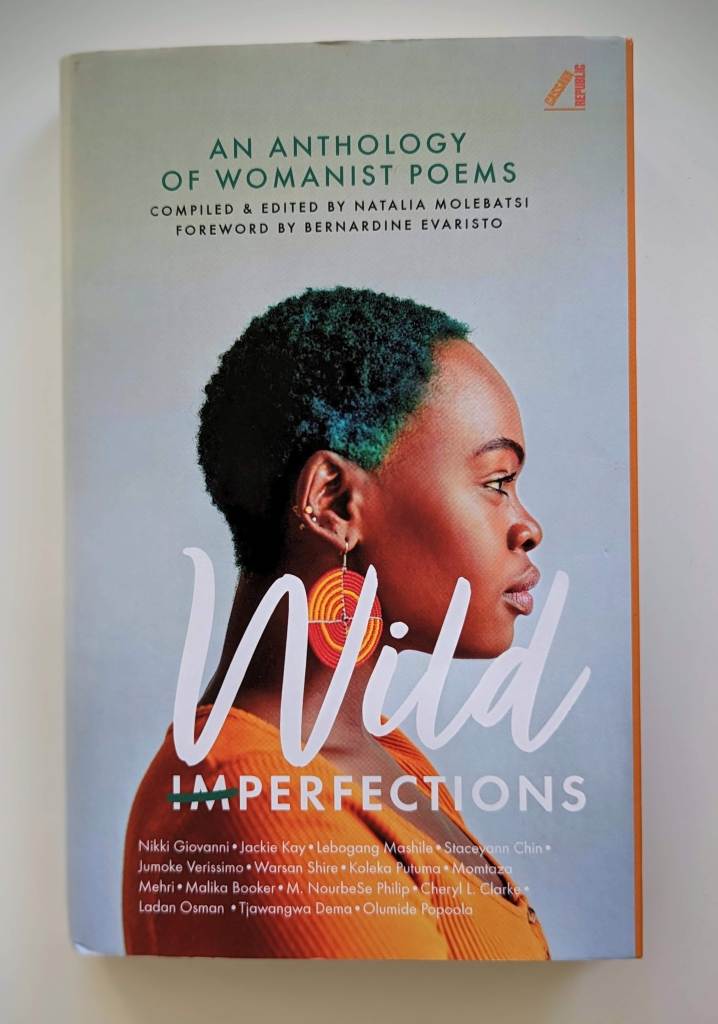
My first stop in Chicago was Semicolon bookstore, a Black woman owned bookstore in River West. The store has a very homey vibe and the shelves are filled with every genre of Black literature a diaspora loving bibliophile like myself can enjoy. While there I bought a womanist poetry anthology: Wild Imperfections; I immediately sat down in the store to read and instantly felt I had started my trip off on the right foot.

Gallery Guichard in Bronzeville showcased dynamic art from across Africa and it’s diaspora, with an air of friendship and community wafting through the gallery as artists spoke of their drive to create.

Sofar Chicago’s Black History Month show in the historic building that was once Vee-Jay Records featured the incredible Mara Love. Mara blessed the audience with a deep soulful voice that seemed a serendipitous throwback to the legends who once recorded in the same space.

The American Writers Museum is an homage to literary legends and a muse to literary legends to be. There I learned: Your words will live forever, and will inspire the people your dreams are not even capable of imagining.

Slow is my poem reflecting on the many poems of Wild Imperfections that accompanied me around Chicago.

Slow

Your wild imperfection
you're perfectly wild

My companion
as I roam
this city
remind me
rest; read

Teach me
wait
read, see, feel
the last word
the last touch
of ink on page

Before
moving fingers
turn the page

I am
a slow learner
then become
slow, learning

Signed,

N.A.

A Familiar Resemblance

“Oh my gosh! I’ve never met anyone that looks like me!” These were the first words my teenage cousin, we’ll call her Sis, said to me after a decade of not speaking or seeing each other’s faces.

A divorce when we were young meant that those who were too young to keep in touch, lost touch. When I was finally old enough to make my own contact, and determined enough to find a current phone number, I reached out. After a phone call filled with joy and surprise, we hopped on facetime later that day, and the first words to leave my baby (though not a baby anymore) cousin’s mouth were like a shot to the heart. I was lucky enough to have remained in contact with the family from whom she had become estranged over the years. There are so many of us, and we all really do look very much alike. Yet, for her, at 15, to see herself reflected in someone else that wasn’t immediate family was a completely new experience.

My family is spread out across several countries on three separate continents. And while it’s cool to have lots of free-housing vacation options, it also means going years, and sometimes decades without seeing each other. Now, in my mid-twenties, I find that while it does take a concerted effort, keeping in touch with most people is definitely doable. But as a child, if I had never met you, or was too young to remember meeting you, it was basically out of sight out of mind.

I remember having a similar experience to Sis when I met some of our cousins for the first time a few years prior. I had always known these cousins existed, and had gotten the occasional email or card after a particularly joyous or tragic life event; but I had never met them, nor had any sort of meaningful relationship with them. I clearly recall walking around a corner and seeing my cousin’s face for the first time and thinking, hey, you look like me.

It was a rare family vacation during which a lot of us were meeting for the first time, or for the first time in many years. We spent a remarkable amount of time commenting on our similarly slender hands, wide noses, bow legs, and squinty eyes. Most of us were teenagers, living completely different lives with arguably very little in common. Yet, we saw ourselves in each other and that made us feel like family.

This experience of literally seeing myself in others is pretty central to my experience of family. However, in Carmen Rita Wong’s memoir Why Didn’t You Tell Me? she describes a photo taken after a family dinner by noting, “Most people would look at that photo and not see one family but a hodgepodge of what looks like unrelated people of all different races. But we were family and are.”

In her book, Wong rivetingly accounts how uncovering a metaphorical Russian doll of her mother’s secrets leads her to question not only her familial relations, but also her entire racial and cultural identity. Wong’s story is shocking, and sometimes sad, but the aspect that really amazed me was that with every uncovered secret, she never lost a family member, she only continued to gain them.

Wong grew up in a family in which she felt like an outsider, not quite looking enough like her mother or sisters or brother. Yet she never reneged on the conviction that they were indeed her family, as disjointed and unconventional as they might be.

For me, oftentimes, I can physically see myself in the faces of my relatives. They literally remind me of the face I see in the mirror every single day. Wong, on the other hand, may not have literally seen herself in her relatives, but they shared so much more than a physical resemblance.

What if you looked at someone else and didn’t see your own face, but you saw your culture, and your language, and your childhood stories? Does this not lend the same immediate sense of recognition? Carmen Rita Wong’s incredibly diverse and convoluted story of family has caused me to question: What is it really that makes family familiar?

Signed,

N.A.