Lumbalú – The African Dream

“Here, we don’t believe in the American dream, we want the African dream.” These words, proclaimed against the backdrop of a mural depicting the Lumbalú death ritual, were the first that met my ears when I arrived in San Basilio de Palenque. Last weekend, I was privileged to take a tour of the historic town, hosted by the Black-owned company Experience Real Cartagena.

Colombia’s Caribbean coast is full of palenques, towns established by Black people who escaped slavery in Cartagena and made homes in the hills so as to be fortified from any Spanish offences which attempted to find and recapture their inhabitants. San Basilio de Palenque, established by Benkos Viohó of Guinea in 1603, was the first of these towns in all of the Americas.

Our guides taught us an array of cultural gems, like Viohó’s creation of a sort of underground railroad helping enslaved people escape Cartagena and set up life in San Basilio, and women’s use of traditional braiding styles to draw maps to freedom. They also spoke highly of their recent legal successes in gaining the State’s official recognition of their autonomous government and administrative mechanisms. Our guides commended Vice President Francia Márquez, the first Black woman to hold her position, for her work in creating diplomatic ties between Colombia and various African countries which have led to educational and language exchanges. They boasted of successful Palenquero musicians who have used their craft to teach the world about their culture.

The Palenquero history of escaping slavery and freedom fighting, as well as some of there more recent legal and diplomatic accomplishments are very similar to those in other parts of the Americas. But there was one recurring trope in the Palenquero stories that struck me as unique: the fervor and tangibility with which the Palenquero people continue to honor their African heritage, particlularly through the Lumbalú death ritual.

Lumbalú, a branch of Santería, is the ancestral religion practiced in San Basilio de Palenque. As part of the death rituals, when someone dies in San Basilio de Palenque, as the casket is carried to the grave, it is followed by women who sing the names of their African countries of ancestry. This is done to lead the deceased person’s spirit back home to the Continent.

As someone who spends the vast majority of my personal and professional life learning about the African diaspora, it’s easy to focus on what’s missing rather than what’s present. I often come across the evidences of the successes of white supremacy and colonialism, usually manifested as popular societal beliefs or stereotypes which denigrate African cultures, religions, and aesthetics. Even on the Continent we see girls getting sent home from school for wearing their afros, native languages becoming scarcer by the generation, and traditional religions being rebuked as evil.

Against this reality, San Basilio de Palenque was a breath of fresh air. As I was guided around the town, the refrain of the day was: here, in San Basilio de Palenque, there is an African dream; through our music and our art, and even in death, we are African and we long to go home.

Over the past several years, I’ve made efforts, inconsistent as they may be, to explore my precolonial history, learn my language, and discover the cosmological beliefs of my ancestors. A feat that is much easier for first-generation me than for a people more than 400 years removed from their ancestral home. Yet, in San Basilio de Palenque, their heritage spills from their lips in the Palenquero language (a hybrid of Spanish and Bantu dialects), is written all over their walls in beautiful murals, and is proclaimed in dance to the visitors they receive from all over the world.

After a day spent in San Basilio de Palenque, I too have renewed hope in the African Dream.

Signed,

N.A.
Reflections in/on the Dominican Republic

I recently spent some time in one of my favorite countries: Dominican Republic. While there, I found myself filled with nostalgia. The island just has that affect on me and I spent a lot of time reflecting on the role it has played in my life. Several years ago, I lived in this beautiful country, and the experiences I had altered the trajectory of my life. Now, every time I go back, it’s as if my spirit anticipates the changes and adjustments the island has the power to spark in me.

When I moved to Cotuí at age 19, I really had no idea what I was getting myself into or what was coming ahead, I just knew that it was part of my spiritual walk through life and my work there would bring me closer to the Divine. What I did not foresee was everything I would learn that fell outside of my then narrow definition of spirituality, those things that would give me new perspectives on humanity and help shape how I would devote my life to changing the world in my own little way.

I grew up in a community with very few people who looked like me or shared my culture. But that’s not to say it wasn’t diverse. There were a lot of people who were just a generation or two removed from immigration, a lot of people whose ancestors’ lives and lands had been disrupted by colonialism and imperialism, a lot of people who used terms like “aliens” to describe human beings, and, of course, a lot of in between. Growing up in that context, I often thought about race, culture, and Blackness. However, the US has this uncanny ability to limit one’s perspective, especially when it comes to race, and living in the Dominican Republic as a young Black woman ripped my blinders right off.

Walking through the streets and talking to literally every stranger I saw in various cities, suburbs, and farm towns in the Dominican Republic taught me so much about race, diaspora, culture, and colonialism’s history and legacy. People perceived me so differently when I had limited Spanish compared to when I acquired that distinct Cibao accent; when my hair was in an Afro compared to in braids; when I was walking around with a white woman, a stereotypical looking “latina,” a Black woman who was a native Spanish speaker, or a Black woman who had limited Spanish. But the starkest and most impactful interactions for me happened when Dominicans perceived me as Haitian compared to when they found out I was American; and when Haitians perceived me as Haitian compared to when they found out I was Nigerian.

The world is grey, so there’s a lot of nuance here for which I don’t attempt to make broad generalizations. That said, when I lived in the Dominican Republic, I had experiences being targeted by authorities, followed by teenagers in the street, and having slurs yelled at me by small children. All racially motivated and all by Dominicans who many US Americans would perceive to be Black. I also had experiences where I was embraced by Haitian strangers because they recognized me as their diasporic sister from whom they had only been separated by a tragic history of transcontinental slavery, but family nonetheless.

There were also so many people who took the time to have deep, informative, and vulnerable conversations with me, people who embraced me as aplatana’, people who taught to me to speak like a Cibaeña, and people who taught me Creole.

These experiences opened my eyes to realities of race and Blackness that I had never before considered. They pushed me to challenge the paradigms I had accepted as a Black woman in the US, and they motivated me to learn more about my own history.

When I came back to the US, I kept learning. I studied discrimination and bias, race and sexuality, and human rights. I dove deep into the racial history of this hemisphere and how that history continues to perpetuate itself in diverse forms. I tried to understand people and the systems that influence us to love or hate each other. And do my best to use this knowledge for love and understanding.

Now, more than seven years after stepping foot on that beautiful island for the first time, I have this cool job where I get to study Blackness in the Americas while traveling the Americas. A few weeks ago I got to step back onto that magical island that started this journey. I watched the ocean pass along the highway, I climbed mountains, I killed insects with Baygon, I danced bachata on the street in front of a colmado, and, after months of being in a place where my Blackness garnered stares, I got to blend in.

With regard to Blackness and the diaspora, I did more reflecting than learning on this trip. But it was a much appreciated reminder that this work of discovering Blackness in all it’s languages, cultures, struggles, and traumas, and forging healing and connection, is a work in which I’m honored to participate.

Signed,
N.A.

Dear Aeden

Today, I visited the grave of an old friend. And I am way too young for that sentence to make any kind of sense or be any kind of fair. Here’s a letter to her:

Dear Aeden,

I never really planned on coming back to this town, for all of the reasons you know all too well. But ironically, if it ever were to happen it would have always been to visit you. Before you passed a few months ago, I never would have thought it’d be a visit like this, sitting here by your grave.

Since you left, I’ve thought so much about our relationship. There was a period of time when we spoke practically everyday, and saw each other almost as much. Then life just got to being life.

I remember the day you told me and some other friends you were diagnosed with cancer. It was 2020 when all of us still had no idea how the world was about to change. It couldn’t have been more than a couple weeks later that the whole world shut down. And shortly after, I moved to a different state, then a different country.

We kept in touch, but life was just different. The love and the sisterhood was always there, but we drifted to checking in once or twice a year.

When you died, it had been about nine months since we spoke. We had tried to meet up but it just hadn’t worked out and we decided to leave it til the next opportunity.

When I heard the news, I immediately felt the weight of our distance, of the months that had passed since we spoke and the years that had passed since we embraced. Your death was so devastating for so many reasons and for so many people, and I was bewildered.

But in the days and weeks that passed, I was overwhelmed by the grand demonstrations of the mark you left on this world. The legacy of love and friendship you left with me was the same legacy of love and friendship you left on an entire community. I couldn’t be here for the celebrations of your life, but even witnessing them from afar warmed my heart.

As I drove through Sardine Canyon today, and got closer to your resting place, I was hit again by a wave of disbelief. Some places are just never the same without the people that light them up.

I’m so grateful I finally got to come visit you today, after all these years. It’s been a long time coming. You changed my life in inexplicable ways. The world is a bit dimmer without you here, but the light you shared will shine forever.

Love always.

Signed,

N.A.

The Magic of Mariane Ibrahim Gallery

I never leave Mariane Ibrahim Gallery without a peaceful heart, an uplifting story, and the inspiration to write. Tonight, the night of the opening reception of Amoako Boafo’s The One That Got Away, I arrived alone but excited to experience the art; and I ended the night in the warm, friendly company of five beautiful Black women. But let’s back up for a bit.

In May of 2022, I embarked on my first solo trip to Paris, France. I stepped out of Charles de Gaulle with basic French and a list of sparsely googled museums and galleries that would help me fulfill my desire to experience all the Blackness Paris had to offer. One Saturday morning I made my way to Mariane Ibrahim Gallery, ignorant to the impact it would have. On display was Amoako Boafo’s Inside Out. I sat for a long while on the blue sofa of the gallery’s second story, and stared in awe at the vibrant pieces on the walls. I’d never before had such an inexplicably touching experience with art. That trip to Paris, and my experience at Mariane Ibrahim Gallery inspired me to seek out Black art and culture everywhere I traveled.

In February 2023, I visited Chicago and Mariane Ibrahim Gallery was top of my list of Black culture experiences in the city. This time, it was the group exhibition Hauntology: Ghostly Matters, and particularly Olukemi Lijadu’s film that completely blew me away. I once again saw deep parts of me reflected on the white walls of the gallery. Not to mention, I met a lovely friend at the gallery who I seamlessly connecting with over art, culture, language, and heritage.

So, this year as I began my journey as a nomad – a journey afforded to me by a job in which I literally study the state of Blackness in the Americas – I knew that, everywhere I went, my top priority would be discovering the diasporic magic of each place I visited. Mexico City is my first destination and, to be honest, the Mariane Ibrahim Gallery is the entire reason I came. The gallery’s third location opened here early last year, and I knew I had to witness it. And when I got an email about an opening reception for a new exhibit – of none other than the artist who I was first introduced to – I knew I had to attend.

As I mentioned, my main goal for this new nomad journey is to uncover the Black culture of the places I visit. And to be frank, Mexico City has posed quite the challenge. Of course there are Black people in Mexico City, but most of Mexico’s afrodiasporic culture and people are based in other parts of the country. While I encounter Black people on a fairly regular basis, it’s been quite difficult to find Afro-Mexican culture here in the city, and that’s been a bit disappointing.

When I entered Mariane Ibrahim Gallery tonight, I was met with the very Black art of Ghanaian Amoako Boafo, and I could see the whole diaspora before my eyes: Black art on the walls, Black people in the rooms, Black clothes on Black bodies, and Spanish, French, and English mingling through the air. After slowly and thoughtfully making my way through the exhibit, I mustered up the courage to approach a group of Black women (English speaking and American accent having) in the courtyard. They welcomed me warmly, and we quickly figured out that we had a mutual friend who was actually on her way to the event. Armed with my new crew (very helpful for introverts such as myself) I met many new people throughout the night. People hailing from the coasts of West Africa to the Caribbean Sea, and we all collectively marveled at the art that reminded us of home and our families and ourselves.

I plan to return to the gallery to muse on the art with less of a crowd. But even with the commotion of tonight, I knew that I made the right decision and that I am exactly where I need to be. My wild and fantastical decision to sell all of my possessions and leave the city in which I had so intentionally made a home for a dream to travel the world and discover the African diaspora has actually come to fruition.

While I’m still on the lookout to learn more about Afro-Mexican culture from Afro-Mexican people, I feel as though I’m on the right track. And if there’s one thing this new lifestyle has taught me in my short experience, it’s to take things as they come. So, “on the right track” has me more than content. And I’m so grateful to Mariane Ibrahim Gallery for continuing to blow me away with exceptional and inspirational Black art all around the world.

Signed,

N.A.

Dede Aloh

When you’re in the middle of a move, adjusting to a new job, preparing for a drastic lifestyle change, and processing a new medical diagnosis… and then your favorite person dies.

Three weeks before that straw hit the camel’s back, I began listening to This Here Flesh by Cole Arthur Riley. On the front cover is a review by Ashley C. Ford. It reads, “This is the kind of book that makes you different when you’re done.” In hindsight, I wonder if it was placed there not as an invitation to embark on a journey, but rather as a notice that my life was about to change.

As I listened to Cole’s voice extrapolating, and dare I say testifying, on “spirituality, liberation, and the stories that make us,” I was struck by her musings on LAMENT. I rewound and relistened several times. Cole asserted that lament is evidence of hope. “Our hope can be only as deep as our lament is. And our lament as deep as our hope.” She explains that we would not lament if we did not have a sincere hope of a better reality. She also asserts that the positivity that people are oftentimes instructed to forge in place of lament is a denial of our physical and mental experience of the tragedies of life and earth. In this sense, lament inherently bears witness to divine glory.

So what is the body’s physical, tangible manifestation of lamentation?

The body wails:

“I don’t know if I’ve encountered better emotional truth-telling than when visiting Black churches. Black people of faith know how to wail… If there was any performance in it, it was the kind of art that is for healing and not for consumption… Black lament is something to behold. Some churches know how to shake the numbness from your flesh.”

I listened to this reimagining of lamentation as a physical embodiment of hope as I made preparations to sell all the physical comforts of my home. At this point, I had yet to shake the numbness.

“Sister June taught me how to grieve with my body,” says Cole. “She taught me how to feel the tears on my face and not wipe them away.”

I trecked back and forth to doctor visits trying to uncover why my body seemed to be screaming at me. There were no tears on my face, yet.

Cole says “there is no such thing as a lone wail.” She says that “when God bears witness to our lament we discover that we are… inviting God as a nurturer – a mother who hears her child crying in the night. She wakes, rises, and comes to the place where we lie. She rushes her holy warmth against our flesh and says, I’m here.”

When people ask me what I believe in, I always mention the company of my ancestors. Since I was a child, I’ve been consistently blessed with their companionship. For me, they are the God(s) that bear witness to my life, who surround me with their holy warmth.

But with everything going on, I had yet to wail.

When I heard the news, that news that Dede Aloh was gone, lament came without any effort at all. I got off the phone and, as if in a trance like state: I changed into comfortable clothes; I covered my hair; I turned on Igbo gospel music, loud enough to bother my neighbors and call on my ancestors; I got in my bed. Then, I wailed, I wailed like I don’t believe I ever have before. I wailed in the company of my ancestors and in harmony with the chorus shouting hopeful praises to God, I wailed.

“Your wails are worthy to be heard… it’s called healing.”

This is probably also a wailing of sorts, and I am healing. In all the ways and of all the things.

Hopefully signed,

Daa Aloh, N.A.

Soft Luxury in Chicago

The Mariane Ibrahim gallery is a consistently edifying experience. Last year, I found myself stunned and awed at the Mariane Ibrahim gallery in Paris. Stunned because who knew that my whimsical decision to explore Blackness in Paris could lead me to such a breathtaking experience? And awed because of the inspiration and comfort I felt in the face of Amoako Boafo’s expansive painting of a woman playing tennis. This moment was the impetus for my continued whimsy, and led to my walking into the Mariane Ibrahim gallery in Chicago’s West Town 9 months later.

What I felt this time was once again unpredictable. I was met in the entrance by a list of names, unknown to me, yet familiar in their Nigerian-ness. Upon seeing the first painting, I exhaled a breath I wasn’t aware I was holding. As I strolled, I was enveloped by feminine energy, Blackness, and a sound that embodied all the lovely parts of noise and all the juicy parts of quiet.

The highlight of my sojourn in the gallery this time around was the viewing of Olukemi Lijadu’s Guardian Angel. A piece which touched on love and history, family and art, religion and colonialism. In short, everything I could have asked for.

The Mariane Ibrahim gallery is a soft luxury that always rejuvenates my spirit. It was the ostentatious centerpiece of my Chicago experience.

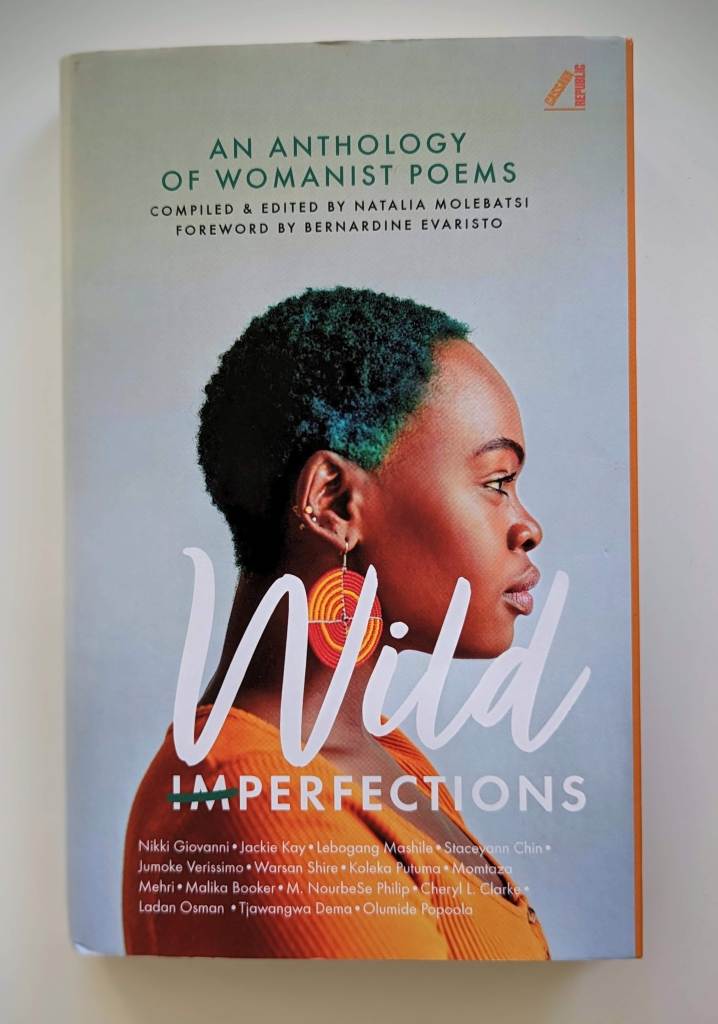
My first stop in Chicago was Semicolon bookstore, a Black woman owned bookstore in River West. The store has a very homey vibe and the shelves are filled with every genre of Black literature a diaspora loving bibliophile like myself can enjoy. While there I bought a womanist poetry anthology: Wild Imperfections; I immediately sat down in the store to read and instantly felt I had started my trip off on the right foot.

Gallery Guichard in Bronzeville showcased dynamic art from across Africa and it’s diaspora, with an air of friendship and community wafting through the gallery as artists spoke of their drive to create.

Sofar Chicago’s Black History Month show in the historic building that was once Vee-Jay Records featured the incredible Mara Love. Mara blessed the audience with a deep soulful voice that seemed a serendipitous throwback to the legends who once recorded in the same space.

The American Writers Museum is an homage to literary legends and a muse to literary legends to be. There I learned: Your words will live forever, and will inspire the people your dreams are not even capable of imagining.

Slow is my poem reflecting on the many poems of Wild Imperfections that accompanied me around Chicago.

Slow

Your wild imperfection
you're perfectly wild

My companion
as I roam
this city
remind me
rest; read

Teach me
wait
read, see, feel
the last word
the last touch
of ink on page

Before
moving fingers
turn the page

I am
a slow learner
then become
slow, learning

Signed,

N.A.

A Familiar Resemblance

“Oh my gosh! I’ve never met anyone that looks like me!” These were the first words my teenage cousin, we’ll call her Sis, said to me after a decade of not speaking or seeing each other’s faces.

A divorce when we were young meant that those who were too young to keep in touch, lost touch. When I was finally old enough to make my own contact, and determined enough to find a current phone number, I reached out. After a phone call filled with joy and surprise, we hopped on facetime later that day, and the first words to leave my baby (though not a baby anymore) cousin’s mouth were like a shot to the heart. I was lucky enough to have remained in contact with the family from whom she had become estranged over the years. There are so many of us, and we all really do look very much alike. Yet, for her, at 15, to see herself reflected in someone else that wasn’t immediate family was a completely new experience.

My family is spread out across several countries on three separate continents. And while it’s cool to have lots of free-housing vacation options, it also means going years, and sometimes decades without seeing each other. Now, in my mid-twenties, I find that while it does take a concerted effort, keeping in touch with most people is definitely doable. But as a child, if I had never met you, or was too young to remember meeting you, it was basically out of sight out of mind.

I remember having a similar experience to Sis when I met some of our cousins for the first time a few years prior. I had always known these cousins existed, and had gotten the occasional email or card after a particularly joyous or tragic life event; but I had never met them, nor had any sort of meaningful relationship with them. I clearly recall walking around a corner and seeing my cousin’s face for the first time and thinking, hey, you look like me.

It was a rare family vacation during which a lot of us were meeting for the first time, or for the first time in many years. We spent a remarkable amount of time commenting on our similarly slender hands, wide noses, bow legs, and squinty eyes. Most of us were teenagers, living completely different lives with arguably very little in common. Yet, we saw ourselves in each other and that made us feel like family.

This experience of literally seeing myself in others is pretty central to my experience of family. However, in Carmen Rita Wong’s memoir Why Didn’t You Tell Me? she describes a photo taken after a family dinner by noting, “Most people would look at that photo and not see one family but a hodgepodge of what looks like unrelated people of all different races. But we were family and are.”

In her book, Wong rivetingly accounts how uncovering a metaphorical Russian doll of her mother’s secrets leads her to question not only her familial relations, but also her entire racial and cultural identity. Wong’s story is shocking, and sometimes sad, but the aspect that really amazed me was that with every uncovered secret, she never lost a family member, she only continued to gain them.

Wong grew up in a family in which she felt like an outsider, not quite looking enough like her mother or sisters or brother. Yet she never reneged on the conviction that they were indeed her family, as disjointed and unconventional as they might be.

For me, oftentimes, I can physically see myself in the faces of my relatives. They literally remind me of the face I see in the mirror every single day. Wong, on the other hand, may not have literally seen herself in her relatives, but they shared so much more than a physical resemblance.

What if you looked at someone else and didn’t see your own face, but you saw your culture, and your language, and your childhood stories? Does this not lend the same immediate sense of recognition? Carmen Rita Wong’s incredibly diverse and convoluted story of family has caused me to question: What is it really that makes family familiar?

Signed,

N.A.

My Small Offerings

Some months ago, I was sitting in a meeting with several of my peers and the conversation wandered to the topic of pets and the, in my opinion, ever-exasperating debate of dogs versus cats. As we went around the room declaring our stances I was met with the usual appall at my calm pronouncement that I don’t like either and that my preferred relationship with animals is that we each stay in our separate corners. One of my friends, in an effort to redeem me in the eyes of our dismayed crowd, asked if I at least have plants. I replied negatively and was met with a response I had never before considered in all of my experience with the perpetual pet debate. It was something along the lines of, and I paraphrase, So you’re the only living being in your home??

That was something I had never considered. I pondered that idea for a moment, but a fleeting one.

In Robin Wall Kimmerer’s Braiding Sweetgrass, she explains that Potawatomi culture (and many other Native North American cultures) holds human and nonhuman life in similar regard. In Potawatomi language there is a distinct pronoun for nonhuman living beings, parallel to he or she for human beings. Plants, trees, lakes, etc. are honored for their contributions to daily life just as we honor the people who add to our lives.

I was intrigued by this paradigm that ascribed to nature a value I had never imagined. I always appreciate a new perspective, but again, I filed it away.

Then, some weeks ago, I was introduced to the word “ecocide.”

Ecocide, noun; destruction of the natural environment by deliberate or negligent human action. (Google).

I heard this word from Yoalli Rodriguez, scholar of environmental racism, ecological grief, and other equally impressive disciplines. In her interview on the For The Wild podcast, Rodriguez delves into the collective grieving of a particular Indigenous community in Oaxaca as the lagoons in their ancestral lands slowly die due to ecocide enacted by the Mexican State. I was struck by the word’s conspicuous similitude to the more common (at least in my line of work) “homicide,” “femicide,” and “suicide.” I was also struck by her explanation of a people grieving for their nonhuman community members, the lagoons.

This time, I reflected for more than a fleeting moment. This community in Oaxaca, and many others all around the world are grieving the loss of loved ones, nonhuman loved ones, but loved nonetheless. And, as Kimmerer explained in her book, these natural beings that are disappearing are not strangers, but family members with whom many Indigenous peoples have had reciprocal, life-sustaining relationships for generations.

I don’t consider myself a participant in this grieving. How can I be when I am only just now learning of the higher value of these dying natural beings, their value independent of my use of them? However, I too know grief, as many of us do. And I don’t believe that empathy is worth much without action.

So, I began to think of what I can do, and here’s what I came up with: 1) learn more, the obvious step one to any change-making. I’ll strive to learn more about the long-held and cherished relationships between earth and people, specifically Indigenous peoples. And 2) I bought a plant. I figured it was time to make some space in my home and heart for another living being.

Many cultures have traditions or rituals of paying respects to those that our grieving. These are my small offerings.

Signed,

N.A.

My Journey to the Sacred Black Feminine

One year ago today I wrote my first Signed, N.A. blog post. The creation of this blog is in large part owed to Transcendant Kingdom by Yaa Gyasi, a book that taught me that books I can relate to actually exist. Since I read Transcendent Kingdom in January 2021, I’ve continued to find books that make me feel truly seen. And now, at the one year milestone of this blogging endeavor, one book stands out among the rest: Dr. Christena Cleveland’s God Is a Black Woman.

In my first Signed, N.A. post a year ago, I mused on my identification with the title Nwanyị Akwụkwọ and set an intention to write and share “reflections on what I’ve learned about myself and the world around me through literature.” When I read God Is a Black Woman I learned things about myself in a deeper way than I ever have before. I felt connection, not only to the author and her story, but also to my ancestors, and maybe even to my chi (s/o to the Signed, N.A. readers who know what I’m talking about). The things I learned and felt from this book were of such a personal nature that I wasn’t sure I wanted to share, and I went back and forth quite a bit on the decision. But, as we arrive at a year of Signed, N.A., and I reflect on the intentions I set at the beginning of this so called pilgrimage, I could only come to one conclusion: to share with you all My Journey to the Sacred Black Feminine

* * *

In the church I grew up in, the most frequently used image of Christ is a painting of Jesus as a blonde-haired, blue-eyed, broad-shouldered, phenotypically white man wearing a bold red robe. Several times over the course of my life, and particularly during my time as an active member of this church, I have paused to think about the implications of this image, or similar ones, being the one I most easily associate with God or the Divine. In recent years, I have taken a furtive and concerted look inward to unpack how what Dr. Christena Cleveland refers to as white male god has influenced how I see myself and how I move through the world.

My journey away from the church I was raised in and toward a more personal divine experience has raised many questions from others, and I often find myself without what I would consider adequate answers. And while I have always and continue to assert that my experience needs no explanation as its depths defy the bounds of human language, I would also like to thank Dr. Cleveland for her book, God Is a Black Woman, which, for the first time, has provided me with some language that I feel comes close to explaining the transformative journey I am on.

Throughout the book, Dr. Cleveland introduces the readers to a Sacred Black Feminine who displays characteristics of a Divine Mother and who descends from on high to wallow in humanity with their child. The Sacred Black Feminine is not perfect and does not look down on me, rather, She shares my experiences, intimately knows my trials, and struggles alongside me. Dr. Cleveland also writes about the importance of valuing and giving credence to Black women’s lived experiences with divinity even when they contradict religious theory or doctrine. Personally, this is a principle I appreciate in all aspects of life. I truly believe that  just because something hasn’t been dissected and extrapolated using scientific theory doesn’t mean that what I or anyone else feels and/or experiences is not true and real. 

It was this distinct cognitive dissonance that caused me to leave behind white male god and seek out the Sacred Black Feminine. As a womanist and human rights advocate, I have a deep conviction for the ideals that we are not free until we are all free, and that the most marginalized hold the key to liberation. These are ideals I try my best to exemplify in my work for justice and equity. Yet, when I stepped back and examined the manner in which I was approaching my personal spiritual liberation, I realized the god I was acquainted with was very distant from my pain, was not familiar with my life experiences, and often made me feel as though I was sprinting in the sand to catch up with someone who started before me, ahead of me, and on solid ground.

It was about four years ago that I first began to more consciously and consistently notice this dissonance in how I saw the world and how I believed god saw me. But as I look back on the expanse of my short life, I do see that the Sacred Black Feminine was whispering in my ear all along.

The first time I heard Joan Osborne’s “One of Us ” in my early teens, I was enamored. It was the first time I remember considering a god like me rather than one whom I was trying to be like. And though I was raised to believe in a loving god, the kind of god Joan Osborne sang about seemed capable of a level of empathy I had never before attributed to the Divine.

This was one of my first whispers. Since then, I’ve become better acquainted with this sort of divine empathy. I’ve known and felt it from the Divine, as well as from the divinity I’ve encountered in others, and manifested in myself. And through a series of gentle whispers and words of encouragement I arrived at an undeniable fork in the road with white male god on high on one hand, and Sacred Black Feminine beside on the other. So, I chose the path of understanding and empathy, the path whose love was designed specifically for me, and was immense enough to be designed distinctly for each individual.

A large part of my journey since then has been arriving at the recognition and acknowledgment that the Divinity within me is just as important as the Divinity outside of me. I’m proud to say that I now exist in “the world of the Sacred Black Feminine in which [I can trust] my experience and embodied wisdom more than reason and tradition. “

So, to others who may be in my shoes, I would like to suggest that you may already know what you’re looking for and where to find it. Just trust yourself, and know that there is indeed a Divine Being who knows you and your experiences so well that she might just be you.

Signed,

N.A.

Ịhụnanya, the price of vision

Of course after years of having absolutely no interest in romance novels, Akwaeke Emezi would be the one to reel me into page-turning devotion of their chaotic yet indisputably alluring protagonist Feyi. You Made a Fool of Death with Your Beauty begins with a sex scene *eye roll*. Personally, sex scenes are my least favorite parts of books, and not even necessarily because of the explicitness, but mainly because reading through one, no matter how relevant and integral it is to the storyline, always makes me wrestle with the urge to shriek “ooh girl, that is not my business!” and close the book. But again, Emezi worked their magic and had me hella uncomfy but undeniably intrigued by Feyi and the rando she was hooking up with. But the true magic of Fool of Death and its genius author is the ability to start off with a bang (pun intended) and still convey that though the forthcoming story plays with vanity, it is most assuredly a serious matter of the heart and soul.

Feyi, the bearer and creator of the beauty the title refers to, is the ultimate protagonist. Throughout the book, the reader is enthralled to follow her down a path that at times seems just messy and at others seems downright unforgivable. Yet the intimacy with which Emezi bears Feyi to the reader ensures no other reaction to her chaos than complete loving support. Feyi is a character we all want to win, and that desire caused me to sincerely interrogate myself as to what I believe love is really worth.

The Igbo word for love is ịhụnanya. A literal translation of ịhụnanya is to see in the eye. I love you: a hụrụ m gị n’anya. Literally: I see you in the eye. What a pure interpretation of what it means to love, to truly see someone… the eye: a window to the soul. Is that what a soulmate is? Someone who sees you in the eye, who sees your soul? If so, what is this vision really worth? Feyi compromises friendship, work, societal opinion, maybe even morals for a chance at this sort of love, this sight into the soul. Would I do the same?

To be honest, I’m really not sure. But the fact that Akwaeke Emezi conjured this whimsical depiction from fiction makes my imagination of the real thing all the more invaluable and worthy of sacrifice.

I came away from Fool of Death feeling enlivened, for death truly is a fool in the face of this kine beauty.

Signed,

N. A.